Organizational Slippery-Slopes (and How to Get on Solid Ground!)

By: Aby Garvey

Imagine yourself climbing a hill. A steep hill. At the top of the hill is everything you’ve ever wanted…happy and loving relationships…. a sense of peace and well being…time to enjoy the things you truly love to do…an organized home that nurtures you, recharges you.

Now, imagine that this hill is made of glass. And you’re wearing socks. And cotton gloves. Everything you want is in sight, and sometimes, when you try really hard, it’s even within your reach. And yet, you never make it to the top of the hill, constantly sliding back down the slippery slope.

Whew. Frustrating isn’t it? And if you’re like so many, getting organized can feel this way. You just about make it to the top of the hill when, whoosh! back to the bottom you slide. So let’s get that thought out of your head, and imagine there’s a rope hanging from the top of the hill…someone has thrown you a life line. You grab the rope, pull yourself up, and climb Mt. Organization once and for all! Now imagine yourself at the top of the hill…enjoying life, your home organized, your heart filled with contentment and joy. Ah, that’s better.

Luckily for you there is no hill of glass that you must climb in your socks to create the organized and happy life you crave. But there are organizational slippery slopes, and if you’re not careful, the habits that create these slippery slopes will move you away from your organizing goals, much like a hill of glass. But not to worry, slippery slopes can be avoided. Here’s how.

Understand what a slippery slope is.
An organizational slippery slope is a habit that, when done in excess, almost certainly leads to overwhelm and frustration (quite like that vision you just had of yourself climbing a glass hill donning socks and cotton gloves.) The trouble with these habits is that there’s no easy way to know when the proverbial line has been crossed. It’s hard to know when you’ve gone too far and created a slippery slope that’s difficult to scale on your own. Here are the most common slippery slopes:

Slippery slope #1: striving for perfection.
This is a particularly tricky slippery slope…because it seems like such a good idea. Many of us have been programmed from an early age to do things perfectly. “Practice makes perfect!” And “if you’re going to do something, do it right,” has been uttered by many a well meaning parent. And it doesn’t stop there. All around us are images of perfection. Magazines are loaded with pictures of perfectly organized spaces, like closets, where not only is every garment precisely spaced and hanging on wooden hangers, but all the clothing in the closet matches! Beautiful? Sure. Attainable? Not for most. And if so, at what cost?

Striving for perfection is also tricky because it spawns other organizational slippery slopes, things like procrastinating on important tasks because you’re afraid they won’t get done well enough, to not handling your filing or bill paying (at all) until you can develop the perfect system.

Perfection is a slippery slope because it is unattainable. Very few things (if any) are actually perfect. To get back on solid ground, you must want something different. Strive for progress not perfection. Decide here and now your goal is to do things better and do them done. Paying bills using an imperfect system is better than not paying them at all. Replace those old messages about perfection with a new mantra: “If you’re going to do something, do it done!” (Or try this one: “practice makes progress.”)

Organizational slippery slope #2: using a bag or box (that isn’t intended for the trash or recycle bin) as temporary storage for items you’ve “decluttered.” If you have even one plastic bag or cardboard box stuffed with dissimilar items from a past de-cluttering binge, guess what? You’re on a slippery slope. Here’s why.

It’s likely you stashed these items in the bag or box with good intentions of “getting to it later.” Right? Well, that’s where things start to get slippery. If you can’t answer specifically when you’ll be dealing with the items in the box, you’re on a slippery slope. If you weren’t motivated to handle the items in the box when you had a concrete deadline (people coming to your home!) will you be more likely to deal with these items after they’ve aged for a few days, weeks or months? I’ve seen enough dusty bags and boxes filled to the brim in the spirit of de-cluttering to know the answer is “no.”

To get on solid ground, de-clutter when you de-clutter. Stuffing items into a box is camouflaging your clutter…not truly de-cluttering. Instead of using a box as temporary storage, grab a box and use it to transport items back to where they really belong. Deal with the two minute to-do’s. Schedule any to-do’s that will take longer than two minutes in your planner or task management system. Decide to decide…if you aren’t going to use the craft store, pizza place or linen superstore coupon in the next week, throw it away! In short, de-clutter now instead stuffing it in a box and saving it for later.

Organizational slippery slope #3:
storing items on the floor. Storing items on the floor is a slippery slope because floors are big! There is no limit to this strategy aside from the four walls of the room whose floor has fallen victim to this strategy. So what starts out as a small pile in the corner can easily (and in very little time) creep into a mound of stuff that covers the entire floor.

To get back on solid ground, set storage limits. Store items on shelves or in cabinets or in your closets–where they can live comfortably and safely. Shelves, cabinets and closets have built in limits. Only so much fits! When these storage areas get too full, you’ll be prompted to take action and create space by letting go of some belongings. Remember, if you’re putting something on the floor, how important can it really be to you?

Organizational slippery slope #4: using flat surfaces to form piles. This is especially slippery when you’re using the pile to remind you to do something. Using flat surfaces to pile things…mail, invitations, sports schedules, forms to return to school, project materials…is very much like storing things on the floor. It’s a slippery slope because there are plenty of flat surfaces in your home. There aren’t clear limits. Establish a limit by adding an in-box or basket to corral your items. And then, empty the in-box regularly, preferably on a daily basis. Dealing with things as soon as they come into your home will avoid creating a slippery slope!

A Quick Action Plan for Dealing with Slippery Slopes

Regardless of where you are on the slope, it is possible to climb back up and conquer the hill. Here’s how.

1. Recognize the habits that aren’t serving you.
Here’s how you can tell if a habit isn’t serving you: it makes you feel bad. You feel stress over the stuff in the box. You’re anxious about the cluttered floor, counter top or table. You’d rather have a tooth pulled, then let someone see “the room!” Once you are aware of the habits that aren’t serving you, take action.

2. Dig out. Go through those boxes and put away, throw away or donate the items you no longer need. Create space if you need it by getting rid of things that no longer fit–your home or your life. Get started on that project you’ve been stalling on out of the temptation to do it perfectly. Commit to doing it done. You can do this! And you’ll be so glad you did!

3. Commit to a new habit.
Once you’ve cleared out and overcome perfection inertia, replace your slippery slope habits with new ones that keep you on solid ground.

4. Seek help if you need it. If you recognize that you’re engaging in some non-productive slippery slope habits, and yet, the thought of digging out is overwhelming, get some help. Call on your spouse…a close friend…me. Sometimes it’s as simple as talking the project through with someone, so you can build a plan and structure around your organizing goals. Don’t spend another day struggling to get up that slippery slope!

Remember, the best way to avoid slipping over the edge is to never get near it. Stop striving for perfection. Quit de-cluttering by temporarily storing items in boxes or bags you’ll get to “someday.” Make a pact now to stop using flat surfaces like floors or countertops for storage. Set limits, create new, healthy habits and in to time you’ll find yourself standing firmly (and happily) on solid ground.

(Aby Garvey is a professional organizer and the owner of simplify 101, inc. Her mission is to help you create time and space for what matters most in your home and life. Aby is the author of the e-book “the happy scrapper – simple solutions to get organized and get scrapping!” Visit the simplify 101 website for organizing ideas and to subscribe to Aby’s organizing email newsletter.)

The Importance of Good Thinking

“The wisdom of the prudent is to give thought to their ways.”
Proverbs 14:8 (NIV)

In his book “As a Man Thinketh”, James Allen says, “All that a man achieves or fails to achieve, is the direct result of his thoughts.” Do you believe that? If you do you’ll place a high value on good thinking. It will become a priority in your life. Success doesn’t come by accident. You don’t stumble into it and then figure it our afterwards. Whether you are a business person, a minister, a teacher, a parent, or whatever, your level of success will increase dramatically if you place a high value on good thinking. The better your thinking the better your prospects in life. Playwright Victor Hugo said “A small man is made up of small thoughts”.

People who don’t develop and practice good thinking usually find themselves at the mercy of circumstances — or other people’s thoughts. They’re unable to solve problems. They find themselves facing the same obstacles over and over. And because they don’t think ahead they’re habitually in reaction mode. An old German proverb says “Better an empty purse than head”. Good thinkers overcome difficulties, including lack of resources. And generally poor thinkers are at the mercy of good thinkers.

Ponder these words: “Capital isn’t so important. Experience isn’t either. You can get both these things. What’s important is ideas. If you have ideas you have the main asset you need,and there isn’t any limit to what you can do with your life.” Solomon writes: “As he thinketh in his heart, so is he.” (Proverbs 23:7 KJV) And the good news is — It’s not too late for you to become a good thinker.

Excerpt from The Word For You Today: Bob Gas

Chicken Salad

Ingredients:
1lb. Chicken Breast
1 – 1 & 1/2 cup mayonnaise
3 cups grapes
1/2 – 1 cup almonds
Salt and pepper

Optional: Serve with Croissants

Directions:
Boil chicken breast, drain and shred.
Mix all other ingredients to taste.
Some like a little more or a little less of mayo, grapes, and almonds.

Delicious! Another family favorite!

Figuring Out What Works

I read parenting books, and seek parenting tips all the time. Just like you I am always seeking out the best way to be the best mom.
I have found that some of the best parenting advice does not come from highly educated therapist, but from mothers who have raised their children. Even if their children did not “turn out great” they can tell you where they went wrong, the different choices they should have made. It is the pattern God has designed for us, to look to the elders to guide us.

Thus I share something I have, through trial and error, figured out. (Not that I am an “elder” or anything 🙂 ) My children are unique. They do not respond the same way to the same disciplines. One is more sensitive than the other. One seems to be more secure than the other. One can be spoken to in a stern voice while the other will need “physical contact” before she yields to correction. This is why trial and error can be so important, because what worked for one child may not work for another. (I have found this to be especially true with mothers writing about their potty training experience,which I am going through now with Anna)

This does not seem to be a huge revelation, we know our children are different but when it comes to that moment of discipline we tend to fall back to our “old faithfuls”. I have especially exhausted myself recently with Emily. I have realized that not only is it true that what works with Anna does not work with Emily, I have also found that what worked with Emily a year ago does not work now. Creative Parenting is constantly seeking new ways to teach your children and discipline them in such a way that they not only feel the sting of the moment, but that they learn a life lesson that will stay with them. Why is it so important for her to listen the first time? Because in a moment she could be in danger and not listening the first time could cause harm to her. Not only that, but one day she is going to have teachers, employers, and others that are going to need her to do what she is supposed to do. They are not looking for debate, or her to have to be told several times to do something before it gets done. This prepares her for her life, a tool that will help her avoid certain struggles when she is grown. That is truly training a child in the way they should go. (Proverbs 22:6)


    As you discover what will work best for your children here are a few guidelines:

1) Be sure there is not abuse. Strive to not allow the discipline to come out of anger. One way to do this is to discipline quickly rather than allowing them to push you or drive you “nuts” before you act.
2) Be sure that the discipline is not humiliating. You want to teach them, not shame them. Yes, sometimes discipline is embarrassing, but shame is different. Shame strips confidence and the healthy pride your child holds, leaving scars that may stay with them. Embarrassment causes temporary red face that will be forgotten.
3)Be sure to be consistent. While the methods of discipline may change, from time out to a lost privilege, the consistency is to carry out the discipline no matter what. Especially if you have set forth the rule “We are not going swimming” you must not allow them to cry, or worse be sweet, enough for you to cave in. (We were notorious for being sweet to our mom long enough for her to forget that she grounded us)

By the way, just to share…The thing with Emily has been no spanking or time out seemed to be working to correct a certain behavior, she wasn’t even moved to tears by my spankings. She shrugged, no kidding, she shrugged at the idea of a spanking. However, Emily is allowed to stay up an hour after Anna goes to bed. When I took that privilege away from her she was moved to change her attitude. This may be a good idea for a parent out there, so I thought I would share. With that said trust that you know your children, you know what is important to them, and you know what will motivate change. Use it.

Change Begins With Me…

If I allow God to change me, then those that are around me will also change. Either God will change the people that are in my life, or the people that are in my life will allow God to change them.
~ Angel Cope

There was a time my husband and I were having a hard time in a particular situation. If we spoke about the subject, we would never see eye to eye. Ironically, he seemed to see things as I did until I pushed him to do something about it, and then he would pull back and play “devil’s advocate”. This seemed to pour salt in my insecure wounds. I needed his reassurance, but because it was so close to home for him, it was hard for him. Finally, seeking counsel from a wonderful woman, she told me “Look, you knew what you were marrying when you married him, and you need to decide are you going to be right, or are you going to be happy?” I humbly had to accept that this was the choice before me, and I told him I wanted to be happy. As I prayed for God to help my pain, my broken heart, He prodded me to take the first steps in restoring the situation. It was very hard for me. I will just say it; I had to ask for forgiveness of someone knowing I may have never received the same in return. It was so humbling, and required me to let go of my need to prove I was right, or get justice for myself. As I took that step, I cried over the words. Even as I said them, I felt healing pour over me. If all I had received came from that cleansing of that hate, it would have been enough. But God … A few days later I was returned with the same gesture. This person called me and we cried together and realized though we stood on polar ends our heart was the same, for restoration. In choosing to allow God to deal with me, those around me were open to let God deal with them.

This is one of many times God has required me to deal with my part in a relationship, or circumstance, before He could, or would, deal with another. It could have ruined my relationship with my husband, but it didn’t. I could have allowed my insecurity to feed that hurt and rejection. I wanted to. I almost did.

Instead, I had to choose to believe that my husband loved me, and not allow my thoughts to tell me otherwise. In believing that, I could let go of the offense that caused the strife to begin with. I was willing to let it go if I knew he loved me. But here is the thing: he could not do enough, say enough, or be enough to prove that he loved me. I could not believe that he loved me until I was willing to love and accept myself.

The scripture says to love your neighbor as yourself. But this scripture assumes you love yourself. Until you find that peace you will always struggle in your relationships no matter who you are with. The problem follows us because the problem is in us.

Being right was not going to make me happy, but choosing to be happy seems to make things right. Even if this person had not come to me, it would have been o.k. It would not have changed what God had done in me. There have been some relationships which I have tried to apologize, and reconcile things I have done wrong. It was not received. However, I was able to let them go. To not allow them to consume my thoughts and to forgive them though they have not forgiven me. I had a clear conscience that I had done all I could do to reconcile.

I can only change me; I cannot change any one around me, except through changing me. Who we are may not be why someone is the way they are. But when I change me I cause them to have to treat me differently. Sometimes, as we allow God to change us, we may even realize, looking back, that we were the ones who really needed to change.

Organizing Tips

It is Spring Cleaning Time! Are you ready? Here are a few tips.

Decide where to store things based on accessibility.
If you always take your shoes off at the front door, create a center for them. Maybe a chest or decorative item that can also be used as storage.
If you can toss your shoes in there they are more likely to be out of the way, and clutter free.

For easy stacking, buy plastic containers the same size.
Be sure to label each one of them, I use masking tape on top and sides to label. Using plastic containers is much better than cardboard. It keeps items safer, plus cardboard draws bugs, like roaches. (Someone told me roaches can live on the glue from a cardboard box for years….UGGGHH!) I go to places like Big Lots or Fred’s, close out stores, to buy my plastic containers inexpensively.

Be sure to clean out storage areas about once a year.
Every time we go through our things, my husband finds a few more things he is ready to get rid of. (He is the sentimental packrat)
As you add more storage, you must take away something!

Sort and store similar items together.
For instance all of my girls clothes are together in the garage. They are clearly labeled “Anna — Summer ’06 — 12-24 months”
I find that when I know someone needs clothes, or I need to pull out Emily’s “hand-me-downs” for Anna, I can easily access the sizes and the season needed.

The Importance of Community…

One of the most thorough research projects on relationships is called the Alameda County Study. Headed by a Harvard social scientist, it tracked the lives of 7,000 people over nine years. Researchers found that the most isolated people were three times more likely to die than those with strong relational connections.

People who had bad health habits (such as smoking, poor eating habits, obesity or alcohol use) but strong social ties lived significantly longer than people who had great health habits but were isolated. In other words, it is better to eat Twinkies with good friends than to eat broccoli alone. ~John Ortberg excerpt from “Everybody’s Normal”

Everybody's Normal Till You Get to Know Them When my Pastor quoted this passage a couple of Sunday’s ago my sister and I quickly agreed that she and I would, together, live forever. 😉 Seriously though, WOW! We hear so much about needing to eat right, exercise, and watch our weight. We are constantly bombarded with all the different diet “formulas”, and we hear over and over about the importance of vitamins, and which supplements to take to have healthier, longer lives, but it turns out the most important ingredient of all is relationships!

Even God said “It is not good for man to be alone” (Genesis 2:18). Here was a profound statement from my Pastor, that God in all his glory whom Adam walked with and had full access to, was not enough for him. He needed relationship with his own kind, thus God created woman. It is easy for us to isolate ourselves with our busyness, and we often use the excuse that we have so much going on. Yet how much are we actually communicating and pouring into and receiving from other relationships? We no longer reach outside of ourselves into our community. Still we are more busy, more tired, and more sick than ever.

Isolation unto ourselves can cause us to lose perspective. One woman told me that when she counseled with other people and then came home at the end of the day her problems seemed so insignificant. The irritating things about her life weren’t that big of a deal when looking at the bigger picture. Now that she stays at home, she does not have the reminders and sometimes forgets about how blessed she is. As for me, I find that even having single friends helps my perspective. There are times when I talk to my single friends and they talk about dating, and how hard it is. I remember that the grass is not greener on the other side. I also remind them to not marry unless they find the right one, and to not settle, because marriage is full of its own problems and struggles as well, and you want it to be with someone who is going to cherish you and work at this thing as hard as you do.

Joyce Meyers wrote in “The Confident Woman” of two seas that the Jordan River flows into. The first is life-giving; children play and swim there, and it is full of fish, and life, and trees grow by its shore. The second has none of those things. It has no life, no fish, no trees. The water is so full of salt that you would float if you tried to swim in it. The first one is the Sea of Galilee, where Jesus taught and could often be found. The second, I am sure you have guessed, is the Dead Sea. One has life, the other death. Why? They both form from the same river. Yet only one both receives and gives freely, and breeds life. The other takes in, gives nothing of itself, is isolated, and death is all that is there. I have even recently heard reports on the news that the Dead Sea is slowly disappearing, half of what it was, and no one knows why.

Think about that for a moment … the difference between life and death is giving of what you have and receiving from others what you don’t.

Take the time to have a cup of coffee with a friend, or a few. Pour into them, and allow them to pour into you. Take time to sit with your family at the dinner table and spend time with those you work so hard to give a good life. Nurture your relationships! “And let us consider how we may spur one another on toward love and good deeds. Let us not give up meeting together, as some are in the habit of doing, but let us encourage one another …” (Hebrews 10:24-25)

Tying Your Shoes

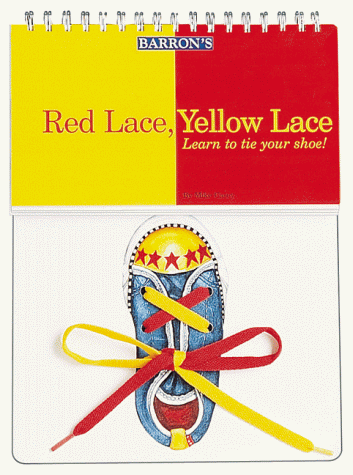
Red Lace, Yellow Lace
I am currently working with Emily at tying her shoes. While the book “Red Lace, Yellow Lace” is great for having the laces and shoe cut out for her to practice on, I wasn’t crazy about the poem in the book. I searched for a poem I remembered from my childhood, “Bunny going around the tree” (or something like that), but found nothing, except for others asking if anyone knew the poem. However, I did find these two great poems to help a kid out! If you don’t want to buy the book, you can buy two different colored shoelaces and cut them half and retie the two different colors together. This makes it easier because you can say “Red Lace” or “Yellow Lace” instead of “this string” or “that string”.

PS: If anyone does know the poem about the “Bunny Boy”, please leave a comment!!

Teepee Tying
Build a tee pee
Come inside
Close it tight so we can hide
Over the mountain
And around we go
Here’s my arrow
And here’s my bow!

Criss Cross Tying Shoes
(tune: Splish Splash I was taking a Bath)
Criss Cross and go under the bridge
Then you got to pull it tight.
Make a loop but keep a long tail
That is how to do it right
Then you take the other string
and you wrap it ’round the loop
Pull it through the hole
Now you got the scoop